Home › Specifications › Hitachi Energy Grid-eMotion Fleet
Hitachi Energy · Charger sheets
Hitachi Energy Grid-eMotion Fleet
A depot system sold together with its grid connection: a railway-style central rectifier (up to 2.25 MW) feeds 500 kW charger cabinets and dispensers of 300 or 500 A per plug, plus roof pantographs of up to 600 A. There is no MCS plug. Hitachi Energy is.
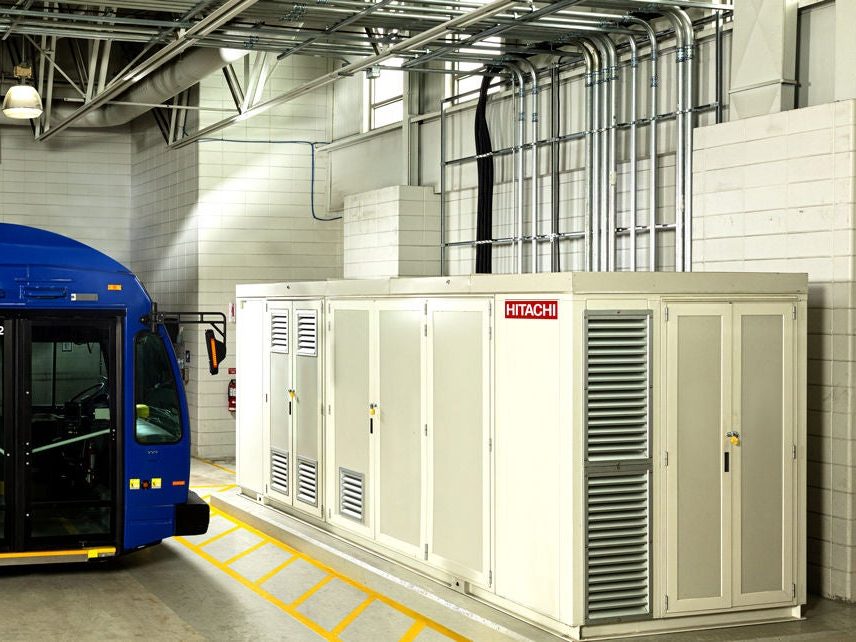 Photo: Hitachi Energy
25 of 43 values are filled in.
Know one we are missing, or one that is wrong? This sheet is open for anyone to correct — type into it on eTRUCKTCO.eu, press Review & send, and confirm the e-mail. It is on all three sites the moment we have checked it.
Correct or complete this sheet
Company 4 / 4
IAA Transportation 2026 2 / 5
| Hall and standAs in the IAA exhibitor directory; Hitachi Energy's own event page says "Hall 21 Booth 61". Earlier on this sheet: Hall 21, Booth 61 | Hall 21, Stand B61 | ↗ ↗ |
|---|---|---|
| Premiered in HanoverWorld or European premieres on the stand | not published | |
| Charging products on the standModels shown | Grid-eMotion Fleet, Grid-eMotion Flash | ↗ |
| Announcements at the showPartnerships, orders, launch dates | not published | |
| Who to talk to on the standName and role, as the maker publishes it | not published |
The charging system 11 / 19
| ModelProduct name as sold | Grid-eMotion Fleet: rectifier and charger cabinets (GeMI-A, GeMI-B) or outdoor containers (GeMO-B, GeMO-C), dispensers GeMD-A, GeMD-C and GeMD-D, roof pantographs GeMP-A and GeMP-B | ↗ ↗ |
|---|---|---|
| ArchitecturePower electronics indoors in a technical room or e-house, or in standard outdoor containers. Hitachi Energy says this removes large sub-distribution boards and distributed converters | Grid-to-plug split DC: a converter transformer and one central rectifier (a railway design) turn the grid supply into DC, charger cabinets send DC to the dispensers, and the dispensers do no conversion | ↗ ↗ ↗ |
| Power per cabinet or unitPer GeMI-B charger cabinet (up to five DC/DC modules). The central GeMI-A rectifier is rated 1.75 to 2.25 MW; the outdoor GeMO-B container 2 MW | 500 kW | ↗ |
| Power-sharing stepSize of one DC/DC module in the GeMI-B cabinet; GeMO-B container: 100 kW | 75 / 100 kW | ↗ |
| Outlets per power unitNot published per cabinet. Dispensers have one or two plugs; with sequential charging one group of modules serves two plugs | not published | |
| Max power per CCS outlet | not published | |
| Max current, CCSGeMD-A charge box and GeMD-C free-standing dispenser up to 300 A continuous (air-cooled cable); GeMD-D up to 500 A continuous per connector with liquid cooling, 1,000 A for a two-plug unit. Roof pantographs GeMP-A (depot) and GeMP-B (on-route) up to 600 A. CCS Type 1 or 2 | 300 / 500 A | ↗ |
| Megawatt Charging System (MCS)No MCS dispenser in the 2026 Grid-eMotion Fleet brochure | no | ↗ |
| Max power per MCS outlet | not published | |
| Max current, MCSMCS connector allows up to 3,000 A | not published | |
| Output voltage rangeDC output voltage not published. The GeMO-C transformer takes 4.16–24.7 kV on the grid side | not published | |
| Efficiency, grid to plugAs published by the maker | not published | |
| Loss grid to battery, overnight depotAs assumed in the eTRUCKTCO calculators | Not in the calculators % | ↗ |
| CoolingLiquid-cooled cables / air | Rectifier cabinet cooled by natural air; charger cabinets and the GeMO-B container by forced air; GeMD-D dispenser with liquid-cooled cable, GeMD-A and GeMD-C with air-cooled cables | ↗ |
| Cable lengthGeMD-C and GeMD-D: 5 m (GeMD-D liquid-cooled); GeMD-A charge box: up to 10 m | 5 / 10 m | ↗ |
| Protection and temperature rangeCertification CE, UL and CSA (outdoor containers UL and CSA) | Dispensers IP54 / NEMA 3R, −35 to +50 °C with derating above 40 °C (GeMD-A −25 to +50 °C); indoor cabinets −5 to +45 °C; outdoor containers NEMA 3R, −25 to +45 °C | ↗ |
| Noise | not published | |
| Battery bufferBuilt-in storage to soften the grid peak, if any | not published | |
| Size and weightMaker's claim, from the London bus depot project | No dimensions published; Hitachi Energy says the system needs up to 60 % less space and 40 % less cabling than alternatives, and the dispensers do no power conversion | ↗ ↗ |
Software and standards 2 / 4
| OCPPVersion | not published | |
|---|---|---|
| ISO 15118 / Plug & Charge | not published | |
| Load and fleet managementDynamic power sharing, depot peak control | Three ways to link modules to plugs: direct (all module power reserved for one plug), sequential (modules shared by two plugs, for overnight charging) and sequential-simultaneous (switches between the two); the grid connection can be oversubscribed; energy and charging-asset management offered with the system | ↗ ↗ |
| Software offeredBack-end, app, monitoring | Digital energy and asset management; one central router per charger group with wired links to the dispensers (fewer SIM cards); cybersecurity-certified manufacturing process; RFID on all dispensers, 12-inch screen on GeMD-C and GeMD-D | ↗ ↗ |
Buying and running it in Europe 4 / 8
| List pricePer cabinet or per outlet, say which | not published | |
|---|---|---|
| Price per kW installedHardware only or turnkey, say which | not published | |
| Availability in EuropeNo delivery times or prices published | Offered as a project with consulting, finance, hardware, software and service; Hitachi Energy has built charging for battery-electric vehicles since 2013 | ↗ |
| Units delivered in Europe to date | not published | |
| Reference customers in EuropeFleets, operators, hubs | Arriva's Brixton Tramshed bus depot in London (22 electric double-deckers, delivered through Zenobē); Södra Cell's Värö pulp mill in Sweden (heavy electric forklifts) | ↗ ↗ |
| WarrantyYears, service levels | not published | |
| Service network in EuropeOwn technicians, partners, response time | One Hitachi Energy project team from grid study and design to commissioning and service during operation | ↗ ↗ |
| Turnkey partnersWho installs it, including the grid connection | Hitachi Energy delivers the whole installation, from the grid connection to the plug | ↗ ↗ |
On this site 2 / 3
| In the eTRUCKTCO calculatorsWhich option, and with what loss and cost factor | not published | |
|---|---|---|
| Trucks on this site it can charge at full powerSee the truck sheets | Every truck of the T&E comparison except the DAF XG Electric is MCS-capable or announced so (MAN eTGX up to 750 kW): see the truck sheets at /sheets/avs/ | ↗ |
| Anything else worth knowing | Hitachi Energy frames fleet electrification "from both the vehicle-charging and grid-integration perspectives", which is the schedule risk the eTRUCKTCO business case describes under "grid" | ↗ |
Where these figures come from
- Hitachi Energy at IAA Transportation 2026 (Hall 21, Booth 61)
- Hitachi Energy, Grid-eMotion charging solutions for e-mobility
- eTRUCKTCO business case: the four charging systems in the calculators (loss, cost multiplier, auto-selection)
- IAA Transportation 2026, Hanover, 15-20 September 2026
- Apollo Vehicle Safety for Transport & Environment: comparison of electric truck models (AVS377, August 2026)
- Hitachi Energy: Grid-eMotion Fleet product page
- Hitachi Energy, 2026: Grid-eMotion Fleet – Charging more with less (interactive brochure 1JNP006319 rev. A, PDF)
- Hitachi Energy: Grid-eMotion to accelerate sustainable mobility in London (customer story)
- IAA TRANSPORTATION exhibitor directory: Hitachi Energy, hall 21 B61
Other charger sheets
Huawei FusionCharge DS720
Kempower Satellite
Alpitronic Hypercharger HYC400
Siemens SICHARGE UC
Kempower Mega Satellite Flex
Alpitronic HYC1000
Siemens SICHARGE FLEX
ABB E-mobility MCS1200
Milence × Power Electronics MCS
Ekoenergetyka SAT 1500 MCS
AUMOVIO VDO charging portfolio
ZEROVA Sailwind MCS
All 94 sheets